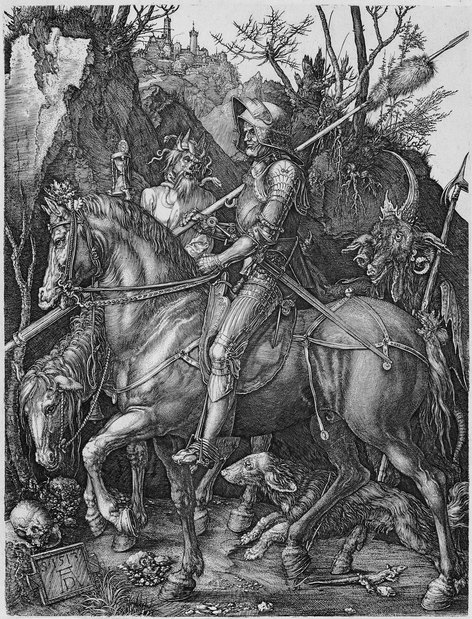
Albrecht Durer, Knight, Death and the Devil, 1513
Copper engraving on paper, 25 × 19.6 cm
Digitized by miscLab
Services / Case Studies
Knight, Death and the Devil
Among Albrecht Durer's prints, Knight, Death and the Devil is one of the most famous, and one of the hardest to reproduce. In the image window on the left, you can view miscLab's digitization of Knight, Death and the Devil and zoom in to inspect the details. The image shows a fully armored knight riding through a narrow mountain path. Death rides beside him, holding an hourglass as a reminder of life's limit; a strange devil follows behind, like an embodiment of desire, fear and temptation. The knight does not look back. His horse moves steadily forward, and the dog beside him keeps running. A distant castle is faintly visible, as the end of the journey and as a kind of spiritual destination. The work was made in 1513 and is one of Durer's most important copper engravings. It is not physically large, yet it contains an almost unbelievable density of information: the reflections on armor, the horse's muscles, the dog's hair, rock textures, leaves, skull, hourglass and distant castle are all built from extremely fine engraved lines. Durer does not rely on continuous gray areas. Instead, he uses line thickness, spacing, direction, crossing and edge condition to make viewers perceive complex light, shade and gray values at normal viewing distance. This is also what makes the work challenging to digitize and reproduce. In an ordinary image, a gray area can often be understood as a single brightness value. In Knight, Death and the Devil, gray is not simply color or lightness; it is the visual result of line structure. One area may look darker because the lines are denser, thicker, darker in ink, more deeply absorbed by the paper, or because their edges have spread slightly into the paper fibers. In other words, the gray scale of this print is a composite object: it belongs at once to image, material, paper and viewing experience. If the scanning resolution is too low, fine lines are averaged too early into ordinary gray blocks. If sharpening is excessive, the lines become stiff and brittle. If noise reduction or compression intervenes, structural details of the print may be mistaken for noise. If flat-field correction, color or reflection control is unstable, subtle paper variation can be incorrectly folded into image judgment. For a work like this, digitization is not simply a matter of making it sharp; it is about preserving, as early as possible, the real relationships among line, paper, ink and micro-contrast. miscLab holds an original impression of Knight, Death and the Devil. We use it as a long-term test object and technical benchmark: each year, we digitize and reproduce it again with the newest equipment, standards, experience and tools available to us. This is not an ordinary scanning task, but an ongoing technical calibration. We re-examine lighting, LCC flat-field correction, color management, plane leveling, reflection control, sampling ratio, multi-frame averaging, stitching and fine-art inkjet output. With this print, errors in any step are amplified: lines may disappear, shadows may block up, the paper white may shift, gray scale may become dirty, and local micro-contrast may vanish in printing. At the print reproduction stage, the challenge becomes even more complex. The black in a copper engraving comes from ink pressed into the paper through line structure, while the black in inkjet printing comes from ink droplets, paper coating and ICC color conversion. The physical mechanisms are completely different. We are not trying to mechanically print the scan file; we are trying to translate the gray values generated by line density in the original into output gray values that the inkjet system can reproduce reliably. This requires repeated calibration among structural detail, overall tone, paper texture and viewing distance. For miscLab, Knight, Death and the Devil is therefore not only a collection object, but also a ruler. Durer's near-limit line density continually tests whether our digitization system is truly improving: whether it preserves more original information, distinguishes material from image more accurately, and builds a more reliable conversion chain between scanning, processing, output and reprinting. Each year's reproduction is a new comparison. What we see is not only the same print, but the change of digitization technology itself in front of the same print.
Applicable Workflow
- First perform high-precision reflective scanning to record paper, line and impression details.
- Perform local restoration, density adjustment and color correction in the digital file.
- Output reproductions, research proofs or exhibition materials through fine-art printing or publication workflows.