Core Technologies
Transmissive Originals
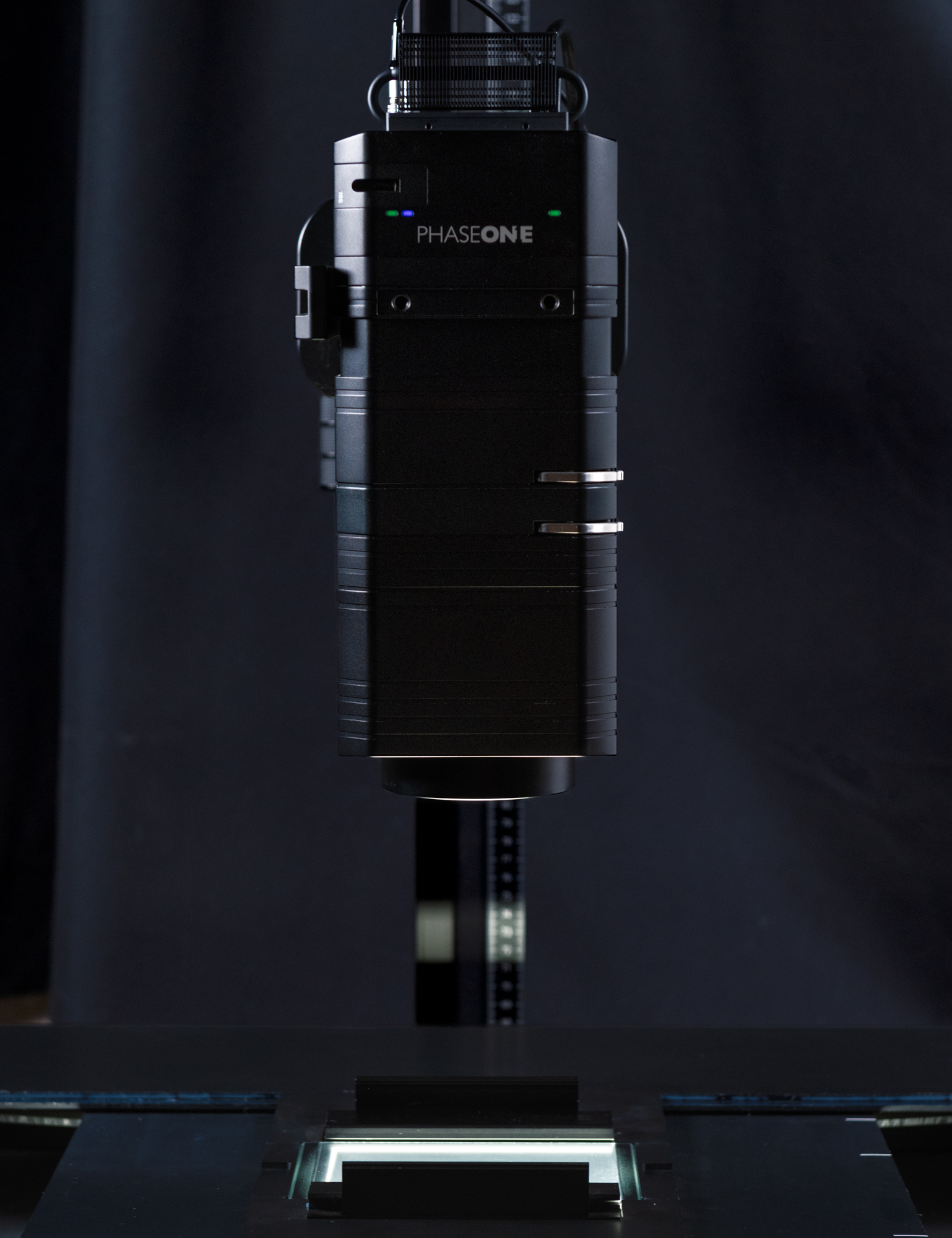
The most common form of transmissive original scanning is film scanning. It is one of miscLab's deepest and most specialized research areas. Around film, positives, negatives and other transparent media, we have built a long-optimized copy-scanning workflow. Its advantage is not only larger file size, but precise control over flatness, lighting, exposure, color and file processing. Related equipment and software are collected under Lab Equipment. Click to view sample
I. Basic Information on Transmissive Original Digitization
Working Environment
Darkroom environment with control of ambient light, scanner component reflections, film-holder reflections and lens flare.
Reference Environment
The documented film-handling environment is 23°C, 45% RH, clean-booth standard.
Working Standard
General working standards exceed common film-scanning requirements in US FADGI and European Metamorfoze guidelines.
Scope
135, 120, 4x5, 8x10, positives, negatives, X-ray film, wet plates and other transparent media. Polaroids and peel-apart film are usually handled as reflective originals.
II. File Parameters and Delivery Formats
Item
Specification / Notes
Standard File Format
Standard TIFF is provided by default; Raw, linearized TIFF, PSB or other project formats can be provided on request.
Single Full-size File
IIQ is about 200 MB. TIFF is commonly about 550-610 MB and may reach about 800 MB when black borders are not cropped.
Stitched File
About 1.5 GB-50 GB, depending on film format, number of stitched sections, bit depth and post-production file structure.
Color Space / Bit Depth
Default ProPhoto RGB / 16-bit, suitable for preserving room for later mask removal and color grading.
Contact Sheet
Mask removal is included by default but color accuracy is not guaranteed. Mainly used for selection and preliminary inspection; JPEG is sent by default.
Negatives
For standard high-resolution scanning, mask removal is generally not provided by default. Linear TIFF is sent so artists can invert and grade according to their own workflow.
Positives / Slides
Regular scans are sent as linear TIFF. HDR scans are merged from bracketed exposures and delivered by default as merged PSB files.
Special Transmissive Media
X-ray film, wet plates and other transparent media use file formats selected according to material, density and final use.
III. Scan Size and Resolution
The advantage of high-precision copy scanning is that it can provide a higher sampling scale and more flexible size control than conventional enclosed scanning workflows. Actual scan size must consider film format, holder, whether edges are retained, lens magnification, stitch count and final output use. Increasing scan size does not necessarily add information to the film itself, but it can increase sampling scale and make grain, color transitions and detail edges appear more natural. For projects requiring large output or close observation of film grain, stitched scanning can further increase sampling.
Film Format
Original Size
Default Scan Size
Equivalent Resolution
300 dpi Output Size (approx.)
135
36 × 24 mm
11827 × 9972 px
approx. 8350-10550 dpi
100.1 × 84.4 cm
120(6×7)
70 × 56 mm
12165 × 9514 px
approx. 4300-4400 dpi
103 × 80.6 cm
4×5
5 × 4 in
14024 × 10652 px
approx. 2660-2800 dpi
118.7 × 90.2 cm
8×10
10 × 8 in
14024 × 10652 px
approx. 1330-1400 dpi
118.7 × 90.2 cm
120 Stitched Scan
Determined by film size and stitch count
Up to 4-32 stitched sections
Recalculated by sampled area
Can support output over 200 cm on the long side
4x5 / 8x10 Stitched Scan
Large-format Sheet Film
Expanded by number of sections
Recalculated by sampled area
Can support output around 300 cm on the long side
IV. Scan Types and Methods
Contact Sheets
Used for selection and preliminary inspection. 120 and 135 contact sheets include mask removal by default but do not guarantee color accuracy. They help identify focus issues, scratches, processing marks or other defects before high-resolution scanning.
Negatives
The basic scan type. Negatives require inversion and mask removal for normal viewing. We generally do not perform mask removal by default, so artists can keep their own workflow and color preference.
Positives / Slides
Because of high contrast, HDR scanning is recommended: bracketed exposures are captured and merged so the digital result approaches visual observation as closely as possible.
Focus-bracketed Scanning
Suitable for media that are hard to flatten, mounted slides, old negatives or surfaces with deeper texture. One image is captured after each fine focus adjustment and then focus-stacked.
Linearization
Basic processing for negative TIFF files to return the file to Gamma = 1.0, reducing conflict between digital curves and the physical film curve and making inversion and mask removal easier.
Stitched Scanning
Multiple samples of film regions are captured and stitched panoramically to obtain larger images and higher sampling scale. Suitable for large output, grain observation and supersampling research.
Special Transmissive Media
X-ray film, wet plates and other transparent media in historic processes can be assessed for scanning. Opaque or translucent instant materials usually move to the reflective-original workflow.
V. Exposure, Color and Open System
Control Item
Description
Exposure Model
High-quality negative scanning needs capture exposure to be as close as possible to the ideal value. Deviation from ideal exposure increases color cast and grading difficulty after inversion.
Model Variables
Ambient light, scanning light brightness, light uniformity, shutter speed, CMOS-to-film distance, curves, white balance, etc.
Model Constants
Copy lens aperture, camera ISO, light-source area, etc.
ProPhoto RGB
The documented miscLab default is ProPhoto RGB / 16-bit, which preserves a wider processing space than Adobe RGB for film digitization and negative mask removal.
Open System
Unlike most enclosed scanners, a copy-scanning system can precisely adjust variables such as film flatness, light quality, color management, film protection and exposure control.
Flat-field Correction (LCC)
Used for light-uniformity control in single high-resolution scans, stitching and supersampling scans. Whether it is enabled depends on media and project needs.
VI. Media Handling and Environmental Control
Dust Removal
An ionizing air gun neutralizes static and removes dust on the film surface; it cannot remove gray marks caused by processing or poor storage.
Flattening
Phase One film holders consist of an optical-glass back plate and side spring clips. Main holders cover 135, 120, 4x5 and 8x10.
Anti-reflective Glass
For film outside holder coverage, optically coated anti-reflective glass is usually used for flattening.
Old Negatives / Slides
When storage conditions or media properties make full flattening difficult, focus-bracketed scanning can keep regions at different heights sharp.
Darkroom
Scanning is done in a darkroom, with tests for ambient light, light-colored wall reflections, film-holder reflections, scanning-table reflections and lens flare.
Matte Treatment
If component reflections are found, related surfaces can be treated with matte materials and lens hoods added when necessary.
VII. Throughput, Transport and Data
Batch Throughput
In an undifferentiated sequential scanning workflow, 135/120 film can reach up to about 1000 frames/day; 4x5 and 8x10 can reach about 240 sheets/day.
Contact Sheet Throughput
Contact-sheet selection scanning takes about 40 seconds per frame, including loading and dust removal.
Standard Turnaround
The usual standard turnaround is 5-7 working days from receipt of film.
Domestic Shipping
SF Express is recommended. Film should be separated in sleeves and protected with rigid cardboard to avoid bending, puncture and abrasion.
International Shipping
DHL or FedEx air shipping is recommended. The sender usually needs to handle customs declaration.
Data Transfer
Cloud drive is used by default, with data retained for three months after scanning. For over 50 GB or confidential projects, delivery by hard drive is available.
Confidentiality
Offline storage and NDA signing can be requested. Regular files are automatically destroyed after the retention period.
VIII. Quality Control and Project Assessment
Item
Description
Issues Eligible for Rework
Focus errors, obvious exposure errors, incorrect scans, missed scans, reversed film loading and uneven film caused by holder operation can be reviewed and rescanned.
File Issue Diagnosis
If later processing reveals abnormal color, mask-removal difficulty or unusual exposure appearance, linearization, reflection/vignetting and Photoshop working-space settings can be checked.
Client Should Provide
Film type, format, quantity, whether edges are needed, intended use, delivery format, and whether HDR, stitching or mask-removal service is required.
Project Quotation
Standard prices are listed under Pricing. Wet scanning, stitching, institutional projects, mask removal, archive management, data centers and dedicated transport are assessed separately by project.
Technical Consulting
Consulting can cover basic mask removal, negative diagnosis, shooting issues, camera troubleshooting and scanning strategy.